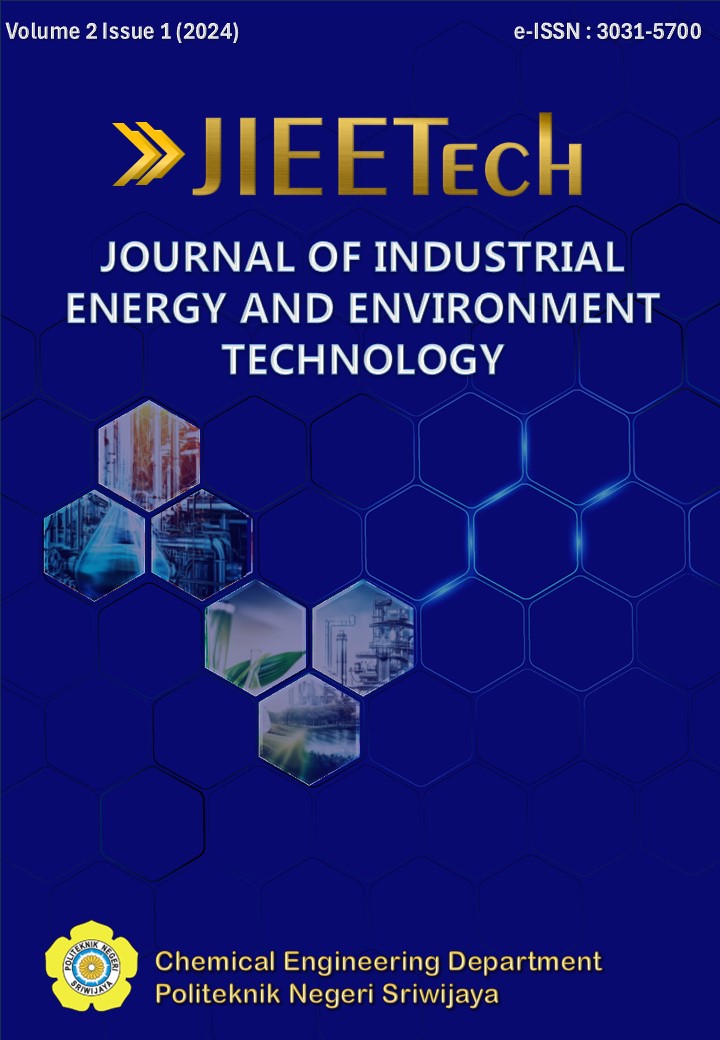
Co-Pyrolysis of Lignite Coal and Rubber Wood Chips to Produce Syngas Based on Feedstock Ratio
DOI:
https://doi.org/10.36257/jieetech.v2i1.9389Keywords:
Lignite Coal, Rubber Wood Chips , Co-Pyrolysis, SyngasAbstract
Co-Pyrolysis is the process of two or more organic materials undergoing chemical decomposition in the absence of oxygen. The purpose of this research is to determine the effect of syngas products produced from variations in the composition of coal and rubber wood chips and the value of specific energy consumption (SEC). In this research, the composition of raw materials 100;0, 75;25, 50;50, 25;75, 0;100 were carried out. From the research that has been carried out, variations in composition affect the characteristics of the syngas product and the resulting SEC value. From the results of the research, the % yield of syngas increased along with the increase in the composition of rubber wood chips used, the highest % yield of syngas was produced in the composition of 100% rubber wood chips by 46.93%. The optimal CH4 content in syngas is produced in the variation of 25% coal composition: 75% rubber wood chips with CH4 content of 63%. In addition, the highest flame height was produced in the composition variation of 100% rubber wood chips, which was 30 cm. The SEC value produced by the most optimal syngas was obtained in the composition of 100% rubber wood chips at 7.879 kWh/kg.
References
Badan Pusat Statistik. Luas Tanaman Perkebunan Menurut Provinsi (Ribu Hektar), 2020-2021. Badan Pusat Statistik. https://www.bps.go.id/id/statistics-table/2/M TMxIzI=/luas-tanaman-perkebunan-menurut-provinsi--ribu-hektar-.html (accessed : March. 2, 2024).
Djamaluddin, Ridwan. Cadangan Batubara Masih 38,84 Miliar Ton, Teknologi Bersih Pengelolaannya Terus Didorong. Direktorat Jenderal Mineral dan Batubara Kementerian Energi dan Sumber Daya Mineral. https://www.esdm.go.id/id/media-center/arsip -berita/cadangan-batubara-masih-3884-miliar -ton-teknologi-bersih-pengelolaannya-terus-didorong (accessed : March. 2, 2024).
Husna, L. Al. (2023). Analisis Komposisi Syngas Co-Pirolisis Batubara dan Tandan Kosong Kelapa Sawit Berdasarkan Variasi Komposisi Bahan Baku. Tugas Akhir Politeknik Negeri Sriwijaya.
Jamilatun, S., Pitoyo, J., Puspitasari, A., & Sarah, D. (2022). Pirolisis Tandan Kelapa Sawit Untuk Menghasilkan Bahan Bakar Cair, Gas, Water Case dan Charcoal. Jurnal Universitas Muhammadiyah Jakarta,1–7. http://jurnal.umj.ac.id/index.php/semnaslit
Khasanah, Uswatun. (2023). Pengaruh Temperatur dan Jumlah Katalis Zeolit Terhadap Produk Pirolisis Sebagai Bahan Bakar dari Bahan Baku Biji Karet. Tugas Akhir; Politeknik Negeri sriwijaya.
Parinduri, L., & Parinduri, T. (2020). Konversi Biomassa Sebagai Sumber Energi Terbarukan. Journal of Electrical Technology, 5(2), 88–92. https://www.dosenpendidikan
Pranolo, S. H., Muzayanha, S. U., Yudha, C. S., Hasanah, L. M., & Shohih, E. N. (2018). Kajian konsumsi energi spesifik sektor industri kimia di Indonesia sebagai acuan efisiensi energi. Seminar Nasional Teknik Kimia Ecosmart.
Ridjayanti, S. M., Bazenet, R. A., Banuwa, I. S., Riniarti, M., & Hidayat, W. (2023). Karakteristik Arang Kayu Karet (Hevea Brasiliensis) Yang Diproduksi Menggunakan Dua Tipe Tungku Pirolisis. Jurnal Belantara, 6(1), 12–22. https://doi.org/10.29303/jbl.v6i1. 815
Susanti, A., Rusnadi, I., & Manggala, A. (2023). Pirolisis Tatal Kayu Karet sebagai Potensi Bahan Bakar Berdasarkan Analisis Temperatur dan Katalis Zeolit. Jurnal Pendidikan Tambusai, 7(3), 21067–21076
Lawrence, A., Thollander, P., Andrei, M., & Karlsson, M. (2019). Specific energy consumption/use (SEC) in energy management for improving energy efficiency in industry: Meaning, usage and differences. Energies, 12(2). https://doi.org/10.3390/en12 020247
Additional Files
Published
Issue
Section
License
Copyright (c) 2024 Catur Aditio, Sukar Apriyanto, Aida Syarif, Zurohaina, Yohandri Bow

This work is licensed under a Creative Commons Attribution 4.0 International License.