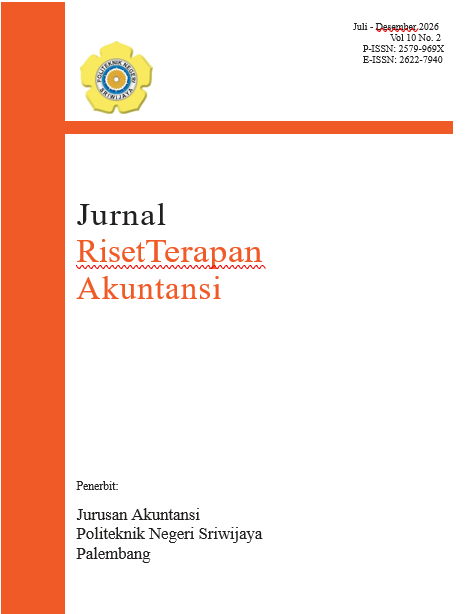
ANALISIS FINANCIAL DISTRESS PERUSAHAAN SUBSEKTOR TEKSTIL DAN GARMEN INDONESIA
DOI:
https://doi.org/10.36257/jrta.v10i2.12306Abstract
The textile and garment subsector plays an important role in the Indonesian economy through its contribution to gross domestic product (GDP), employment absorption, and export growth. However, various economic challenges during the 2020–2024 period increased the risk of financial distress among companies operating in this subsector. This study aims to examine the effects of liquidity, profitability, leverage, and operating capacity on financial distress in textile and garment companies listed on the Indonesia Stock Exchange (IDX) during the 2020–2024 period. The study employed a quantitative approach using secondary data obtained from companies’ annual financial statements. The sample was selected using purposive sampling, resulting in 45 observations from 9 companies that met the research criteria. Data were analyzed using logistic regression, with financial distress as the dependent variable classified into non-financial distress and financial distress categories. The results indicate that liquidity has a negative and significant effect on financial distress, suggesting that higher liquidity reduces the likelihood of a company experiencing financial distress. Meanwhile, profitability, leverage, and operating capacity were found to have no significant effect on financial distress.
Keywords: Financial distress, Liquidity, Profitability, Leverage, Operation Capacity.
Downloads
Published
Issue
Section
License
Copyright (c) 2026 Aulia Fanesha, Keti Purnamasari, Septini Kumalaputri

This work is licensed under a Creative Commons Attribution 4.0 International License.